August 29, 2012

The 53rd ALL ASIAN DX CONTEST - 2012


The 53rd ALL ASIAN DX CONTEST - 2012


CONTEST PERIOD
 (Sept. 1-2, 2012)  (48 hours)  
     Phone: From 00:00 UTC the first Saturday of Sept. to 24:00 UTC the next day

BANDS
 Amateur bands 80m, 40m, 20m, 15m, 10m

ENTRY CATEGORIES
Asian stations Japanese (JA) stations is included
Single Operator
Single Band High Power SO80HPSO10HP
Single Band Low Power SO80LPSO10LP
Single Band All Band High Power SOABHP
Single Band All Band Low Power SOABLP
Multi-Operator Single Transmitter (multi band only)  M/S
Multi-Operator Multi-Operator Multi Transmitter (multi band only)  M/M

DXNon-Asian stations
Single Operator Single Band SO 80SO10
Single Operator All Band SOAB
Multi-Operator Single Transmitter (multi band only)   M/S
Multi-Operator Multi-Operator Multi Transmitter (multi band only) M/M

Note :
1: Single Operator stations means that one person performs all concerned operations during   contest period. Use of Packet Cluster is permitted.
2: Low Power stations are limited 100W output or less. No limitation on High Power        stations.
3: Junior stations' operator age must be 19 years old or younger, and Seniors operators             must be 70 years old or older.(For JA stations only)
4: 10 minutes rule (CQ WW method) is applied to Multi-Operator Single Transmitter         stations. The 10 minutes rule means that only one transmitter on one band is permitted during any 10 minutes period, defined as starting with the first logged QSO on a band. However, one-and only one other band may be used during any 10 minutes period if and only if the station worked is a new multiplier. This rule is applied to not only the running stations, but also to the stations searching for multipliers respectively.

Power, Type of Emission and Frequencies: Within the limits of own station license.

CONTEST CALL
Phone........ "CQ AA Contest"

EXCHANGE
 (1) For OM stations: RS(T) report plus operators' age
    For example (If operator is 25 years old): Phone........5925,
 (2) For YL stations: RS(T) report plus operators' age, but if the operator does
    not want to send her age, RS(T) report plus "00" (zero zero) can be sent.
    For example (the operator is 25 years old):
    Phone........5925 (or 5900),
 (3) For Multi-Operator stations: RS(T) report plus the averaged age of operators,
    but if each operator wishes, the age of active operator can be sent.
    For example (the operators are 25 and 35 years old):
    Phone........5930 for all operators
   (or 5925 for 25 years old operator and 5935 for 35 years old operator),
   

PROHIBITION ON THE CONTEST
 (1) No cross band contacts is permitted.
 (2) No change of operating site is permitted.
 (3) For single Operator and Multi-Operator Single Transmitter entry:
    Transmitting two signals or more at the same time, including cases of
    different bands, is not permitted.
    (Except transmitting two signals to get New Multiplier under the 10 minutes rules)
 (4) For Multi-Operator's entry: Transmitting two signals or more at the same time
    within the same band is not permitted.
 (5) No operation from two sites or more for Multi-Operator's entry.
 (6) No contact made through repeaters is permitted.

POINTS AND MULTIPLIERS
     (1) For Asian stations:
   Points........Completed contact will be scored as follows. Contact among same
   entities will neither count as a point nor a multiplier. Duplicate contact with
   the same station on same band will not count as a point.
    
    80m band .......2 points per Asian QSO. 6 points per Non-Asian QSO.
    10m band .......2 points per Asian QSO. 6 points per Non-Asian QSO.
    Other bands....1 point per Asian QSO. 3 points per Non-Asian QSO.

  Multipliers........The total number of different entities
             (according to the DXCC List) worked on each band.
 
     (2) For non-Asian stations:
   Points.......Completed contact with Asian stations
    (excluding U.S. auxiliary military radio stations in the Far East, Japan)
    will be counted as follows:

     80m band ...............2 points
     10m band ...............2 points
     Other bands............1 point

   Multipliers.......The total number of different Asian Prefixes
    (according to the WPX Contest rules) worked on each band.

 (3) JD1 stations.
   ●JD1 stations on Ogasawara (Bonin and Volcano) Islands belong to Asia.
   ●JD1 stations on Minami-tori Shima (Marcus) Islands belong to Oceania.

 (4) Maritime Mobile Stations
   For all maritime mobile stations at any location (no matter outside or inside Asia),
   completed contacts with only Asian stations can be counted. The total score will                              be published in the contest results. But, they will not be ranked. Contacts points                          with maritime mobile stations will be considered as same as contacts among                         Asian stations. But, it will not count as multiplier.

SCORING
 (1) Multi-band
   (The total of the contact points on each band) x (The total of the multipliers on each band)
 (2) Single-Band
   (The total contact points on the band) x (The total multipliers on the band)

REPORTING
 (1) Submit a summary sheet and logs of only one entry classification.
   E-mail submission will be welcomed.
    ●E-mail submission

        JARL Format   or   Cabrillo Format.

 The E-log Reception list as following URL shows all received E-mail submission by contest.
 These data are automatically updated but it may take several minitues before the list is next updated.
  ● Phone    http://www.jarl.com/contest/eloglist/received-aaph.htm


 (2)The submission address is as follows
   ●E-mail submissions to:
    Phone..............aaph@jarl.or.jp

   ●The submission address of the mail to:
     JARL, All Asian DX Contest, 170-8073, Japan
       Indicate Phone on the envelope.

 Deadlines for submissions:
   Phone..............October 31, 2012

INSTRUCTIONS ON THE SUMMARY AND LOG SHEET
It is recommended to use JARL A.A. Contest Log and Summary sheet which are available from JARL HQ for two IRC and SAE. (Summary and Log are available as "PDF files" from the JARL Web site)
a Each Summary sheet must include your DXCC entity,  callsign used, entry class,   multipliers by band, points by band and total score. It should also include a signed          declaration indicating that you have observed the rules and regulations of the contest. Multi-Operator stations must submit a list of all operators call-sign or name.
b Log sheet must contain band, date, time in UTC, call of station worked, exchange   sent, exchange received, multipliers and QSO points. Use a separate sheet for each band.(For Single Transmitter entry: in order of the time contacted). Multipliers should be clearly marked by entities or Asian prefixes, first time worked on each band.
AWARDS:
 (1)   For both CW and Phone, certificates will be awarded to those having the highest
   score in each category in proportion to the number of participants from each entity and  also those from US CQ Zone 3, 4, and 5 in the United States.
      - If the number of participants are 10 or less there will be an Award only to
    the highest scorer
      - From 11 to 20 ............ Awards to the highest scorer and the runner-up
      - From 21 to 30 ............ Awards to the top three
      - 31 or more ................. Awards to the top five

 (2) The highest scorer among JARL members of each category in each area of
   Japan, under the condition having a ranking within top half,  will receive
   a certificate from JARL. However, this rule doesn't apply to those who
   received the highest scorer of the entity certificate.
 (3) The highest scorer on each Continent of the Single Operator Multi Band
   category will receive a medal from JARL and a certificate from the Minister
   for Internal Affairs and Communications, Japan.
 (4) The highest scorer of the Multi-Operator Single Transmitter and Multi Transmitter
   category on each Continent will receive a medal from JARL.
 (5) Special plaques will be awarded to the stations in the categories mentioned
   in a separate page.

DISQUALIFICATIONS:
 (1) False statements in the report.
 (2) Violations of the contest rules.

ANNOUNCEMENT OF RESULTS:
Results will be published in the Spring, 2013 issue of JARL News and also will be appeared on JARL's web site (http://www.jarl.or.jp).
For those wishing to receive contest results by post, please enclose two IRC with your log.
 The Contest Award will be issued to whom fulfill the certain requirements during the contest period.
 The detailed information will be appeared in a separate page.


15.LIST OF ASIAN ENTITIES:
--                   Spratly Is.
3W,XV                Vietnam
4J,4K                Azerbaijan
4L                   Georgia
4S                   Sri Lanka
4X,4Z                Israel
5B,C4,P3             Cyprus
7O                   Yemen
8Q                   Maldives(*)
9K                   Kuwait
9M2,4                West Malaysia
9N                   Nepal
9V                   Singapore
A4                   Oman
A5                   Bhutan
A6                   U.A.E.
A7                   Qatar
A9                   Bahrain
AP                   Pakistan
BS7                  Scarborough Reef
BV                   Taiwan
BV9P                 Pratas Is
B                    China
E4                   Palestine
EK                   Armenia
EP-EQ                Iran
EX                   Kyrgyzstan
EY                   Tajikistan
EZ                   Turkmenistan
HL,6K,6N             South Korea
HS,E2                Thailand
HZ                   Saudi Arabia
JA-JS,7J-7N          Japan
JD1                  Ogasawara Is.
JT-JV                Mongolia
JY                   Jordan
OD                   Lebanon
P5                   North Korea
S2                   Bangladesh
TA-TC                Turkey(*)
UA-UI8,9,0 RA-RZ     Asiatic Russia
UJ-UM                Uzbekistan
UN-UQ                Kazakhstan
VR                   Hong Kong
VU                   India
VU4                  Andaman and Nicobar Is.
VU7                  Lakshadweep
XU                   Cambodia
XW                   Laos
XX9                  Macao
XY-XZ                Myanmar
YA                   Afghanistan
YI                   Iraq
YK                   Syria
ZC4                  UK Sov.Base Area on Cyprus
(*) only Asian area
Total 55 Entities as of June 1, 2009

Full information visit : All Asian DX Contest 2012

August 27, 2012

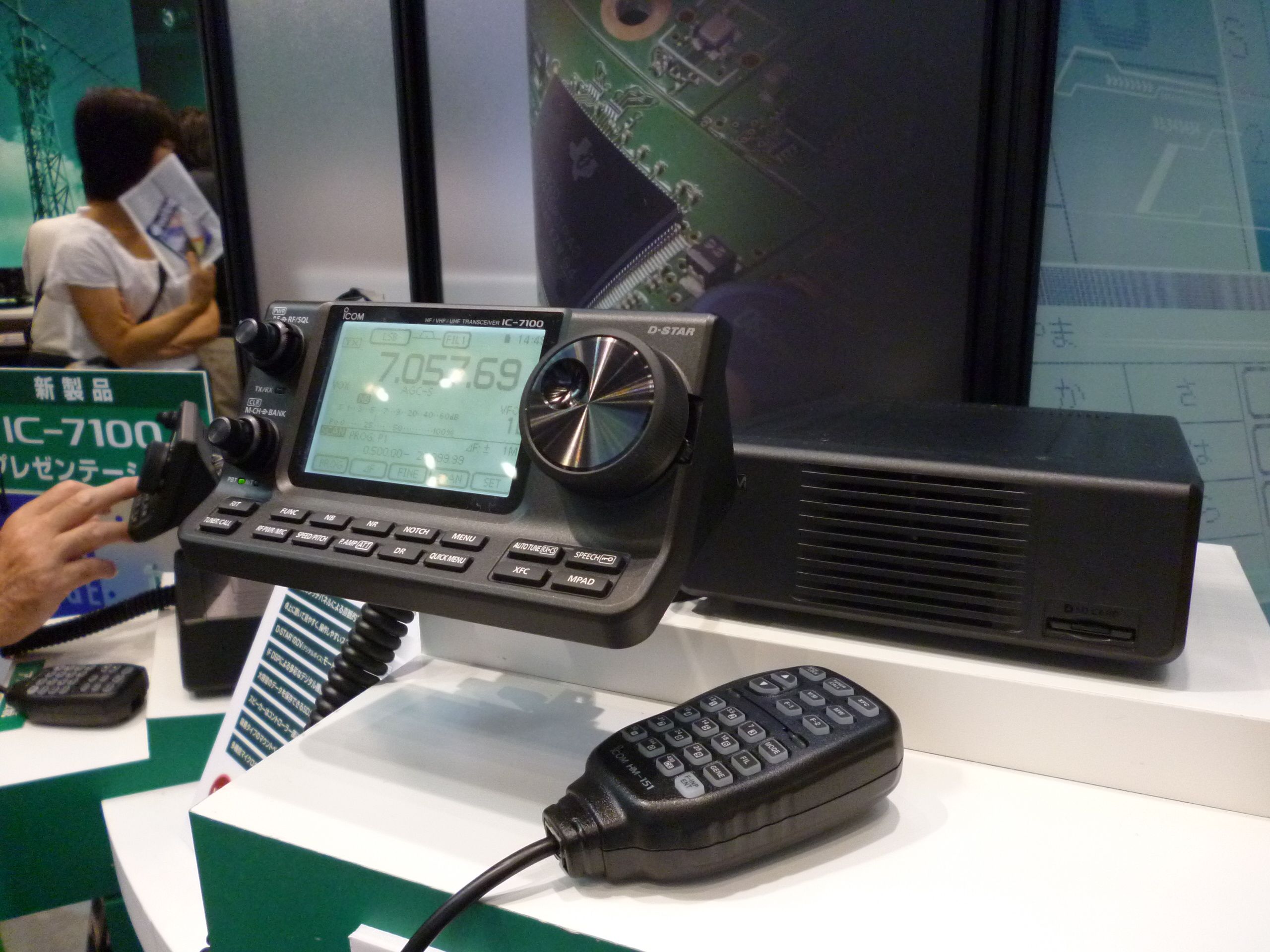
Icom IC 7100

                               image source: http://onjapan.net/2012/hamfair/icom-kenwood-yaesu.html


Icom IC-7100 HF/VHF/UHF Amateur Radio Transceiver


August 17, 2012

Nusantara Award


Nusantara Award

General Rules : 
1. Nusantara Award will be issued to licensed amateurs and SWL around the world for all for all 2 way contacts on HF bands (160m – 10m) including WARC bands. Contacts made after August 17, 1945 count for this award. 
Repeater, satellite, eQSO, Echolink or other relay methods are NOT permitted.
2.a. Basic award is issued for contacting 10 different islands which must include a minimum of 5 out of 6 main islands of Jawa / Java, Sumatera / Sumatra, Kalimantan / Borneo, Sulawesi / Celebes, Irian / Papua, and Bali. 
2.b. Endorsement sticker will be issued in increments of 10 for additional islands worked.
3. All islands claimed for the award must appear on a map and has a name.
4. QSL card must have printed name of the island from which the operation took place. For major or large islands, the name of a town or city on the island, or grid locator maybe sufficient. Please contact award manager when in doubt. 
4.a. Please note that not all islands in this program have an IOTA Reference Number. Small islands, individual coastal islands, island in bay, in lake, in river and in estuary or which cannot be classified in IOTA Program might be still accepted for this award. 
4.b. Group of islands with the same IOTA reference count for separate islands for this award, e.g. Bangka and Belitung are two separate islands for this award (OC-144)
5. Claim must be accompanied by QSL card list (GCR) furnished with the call signs of stations worked, dates, times, bands, modes and island name. Alternatively a list of stations worked with a copy of the QSL cards can be used as well. Applicants using e-mail, may attach the list and scans of the QSL cards. All QSL cards must be in possession and must be produced upon request for inspection.

Application :
1. For DX station, the fee is 8 IRC, or 6 USD, or 5 Euros, for basic award. Endorsement fee is 1 IRC or 1 USD, or 1 Euro regardless of the level claimed. The fee covers the award and postage.
2. There is no fee for handicapped operators or SWL
3. Payment can be made by Paypal (preferred) or cash/IRC (at your own risk), Send the application and fee to Award Manager :

Stephan Busono W2FB (for DX)
3 Margaret Drive, Somerset, NJ 08873 USA
E-mail / Paypal : sbusono(ad)gmail.com
 
Adhi Widodo YB3MM (For DX and Indonesia) :
PO Box 6, Pandaan 67156 Indonesia
E-mail / Paypal: yb3mm(ad)mdxc.org


See website :


July 22, 2012

July 08, 2012

IARU Contest 2012


Full Contest Details

1. Eligibility: All licensed amateurs worldwide.
2. Objective: To contact as many other amateurs, especially IARU member society HQ stations, around the world as possible using the 160, 80, 40, 20, 15 and 10 meter bands.
3. Date and Contest Period: The second full weekend of July, beginning 1200 UTC Saturday and ending 1200 UTC Sunday (July 14-15, 2012). Both Single and Multi operator stations may operate the entire 24-hour period.
4. Entry Categories:
     4.1. Single Operator
          4.1.1. Categories
               4.1.1.1. Phone only – High, Low and QRP power levels
               4.1.1.2. CW only – High, Low, and QRP Power levels
               4.1.1.3. Mixed mode – High, Low and QRP Power levels
          4.1.2. One person performs all operating and logging functions.
          4.1.3. Use of spotting nets, packet, or multi-channel decoders (such as CW Skimmer) is not permitted. Single-operator stations that use spotting nets, packet or multi-channel decoders will be reclassified to the Multi-operator, Single Transmitter category.
          4.1.4. All operators must observe the amateur radio regulations of their country at all times.
          4.1.5. Single operator stations are allowed only one transmitted signal at any given time.
     4.2. Multi Operator, Single Transmitter, Mixed Mode only
          4.2.1. Must remain on a band and mode for at least 10 minutes before changing bands or modes.
          4.2.2. Only one transmitted signal is allowed at any given time.
               4.2.2.1. You are not allowed a second radio that works only multipliers.
          4.2.3. All operators must observe the amateur radio regulations of their country at all times.
           4.2.4. Violation of the band change rules will reclassify the entry as a checklog.
     4.3. IARU Member Society HQ Station
          4.3.1. May have only one transmitted signal per band mode (160 CW, 160 Phone, 80 CW, 80 Phone, 40 CW, 40 Phone, 20 CW, 20 Phone, 15 CW, 15 Phone, 10 CW, 10 Phone) at the same time.
          4.3.2. All stations involved in an HQ operation must be in a single ITU zone.
          4.3.3. Only one HQ station callsign per member society per frequency band is permitted.
          4.3.4. All operators must observe the amateur radio regulations of their country at all times.
5. Contest Exchange:
     5.1. IARU member society HQ stations send signal report and official IARU member society abbreviation. IARU International Secretariat club station NU1AW counts as a HQ station. Members of the IARU Administrative Council and the three IARU regional Executive committees send “AC,” “R1,””R2,” and “R3” as appropriate.
     5.2. All others send signal report and ITU zone.
     5.3. A complete exchange must be logged for each valid QSO.
6. Valid Contact:
     6.1. The same station may be worked once per mode per band for QSO credit.
          6.1.1. Mixed-mode entries may work a station once per mode per band.
     6.2. A station may only be worked for credit in the portion of the band that is generally accepted for the mode used.
          6.2.1. On any band, a station may be worked once on Phone (in the Phone segment) and once on CW (in the CW segment).
          6.2.2. Cross mode, cross band and repeater contacts are not valid QSOs.
     6.3. Where contest-preferred segments are incorporated into regional band plans, participants must observe them.
     6.4. The use of non-amateur radio means of communications (e.g. telephone or the Internet) for the purpose of soliciting a contact (or contacts) during the contest period is inconsistent with the spirit and intent of these rules.
     6.5. Use of self-spotting techniques on packet or other mediums are inconsistent with the spirit and intent of these rules.
7. QSO Points:
     7.1. Contacts within your own ITU zone, as well as QSOs with any IARU-member society HQ station or IARU official (counting as the special multiplier), count one point each.
          7.1.1. Contacts with a station in the same ITU zone but on a different continent count one point.
     7.2. Contacts within your continent (but different ITU zone) count three points.
     7.3. Contacts with a different continent and IARU zone count five points.
8. Multipliers:
     8.1. The total number of ITU zones plus IARU member society HQ stations worked on each band (not mode). IARU officials represent a maximum of four multipliers per band (AC, R1, R2 and R3).
     8.2. IARU member society HQ stations and officials do not count for zone multipliers.     
     8.3. To qualify as the special multiplier, Administrative Council and Regional Executive Committee stations must only be operated by the individual station licensee as a single operator entry or as a multi operator, single transmitter entry with significant participation by the licensee.

9. Scoring:
     9.1. The total number of QSO points times the total number of multipliers worked.
10.  Reporting:
     10.1. Entries must be postmarked or emailed no later than 30 days after the end of the contest (1200 UTC August 14, 2012).
     10.2. Electronic entries must conform to the Cabrillo file format.
          10.2.1. The Cabrillo file format and specifications may be found at http://www.kkn.net/~trey/cabrillo/ or in the November 1999 issue of QST magazine.
          10.2.2. Any entry which has been generated using a computer (either during the contest or after the contest) must be submitted either as an attachment to an email or on a 3.5” diskette.
          10.2.3. Electronic files must use the entrant’s callsign as the file name.
          10.2.4. The log file must be a chronological list of QSOs as made not separated by band or mode.
          10.2.5. Entries sent as attachments to email must be sent to IARUHF@iaru.org
               10.2.5.1. Email entries must include the call sign used during the contest on the SUBJECT line of the email.
          10.2.6. Entries sent on diskette should be mailed to: IARU HF Championship, IARU International Secretariat, Box 310905, Newington, CT 06111-0905 USA.
               10.2.6.1. Diskettes must be clearly labeled with the station call sign, contest name, entry class and date.
     10.3. Participants may manually convert their paper logs to a Cabrillo log one QSO at a time and submit their entry using the web applet found at www.b4h.net/cabforms.
     10.4. Paper logs must be in chronological order, not separated by bands, and clearly indicate for each contact: band, mode, date, time (in UTC) callsigns, complete exchanges sent and received, multipliers and QSO points.
          10.4.1. Multipliers should be marked in the paper log only the first time they are worked on each band.
          10.4.2. Paper logs with more than 500 QSO’s must include dupesheets (an alpha-numeric list of all callsigns worked, broken down by band and mode.)
          10.4.3. All contacts in paper logs must be in chronological order, not separated by bands.
          10.4.4. Paper logs must be mailed to IARU International Secretariat, Box 310905, Newington, CT 06111-0905 USA.
     10.5. All paper entries must include an official summary sheet or reasonable facsimile thereof with complete contest information.
11. Awards:
     11.1. A certificate will be awarded to the high scoring entry in each category in each ITU zone, each DXCC country and each ARRL Section.
     11.2. A certificate of participation will be awarded to each IARU member society HQ station and to each Administrative Council and Regional Executive Committee station..
     11.3. Achievement level awards will be issued to those making at least 250 QSOs or having a multiplier total of 75 or more.
     11.4. Additional awards may be made at the discretion of each country’s IARU member society.
12. Conditions of Entry:
     12.1 By submitting a log to the IARU HF Championships, the submitter agrees that the log may be made public, at the discretion of the Contest Sponsor.
     12.2. Each entrant agrees to be bound by the provisions of this announcement, by the regulations of his/her licensing authority, and by the decisions of the ARRL Awards Committee, acting for the IARU International Secretariat.
13.  Disqualification:
     13.1. Any entry may be disqualified if the overall score is reduced by more than 2%.
     13.2. For paper log entries:
          13.2.1. Score reductions do not include correction of arithmetic errors;
          13.2.2. Any paper log entry may be disqualified if more than 2% of duplicate QSOs are left in the log and claimed for credit; and
          13.2.3. A three-QSO reduction will be assessed for each duplicate QSO found during log checking or for miscopied callsigns.
     13.3. For electronic logs, a one-QSO penalty will be assessed for a miscopied callsign.
14.  Additional Rules:
     14.1. For situations not covered in these rules refer to the ARRL General Rules for All Contests and the ARRL Rules for Contests on Bands below 30 MHz.
15. Additional Information:
     15.1. Questions may be directed to contests@arrl.org or IARU HF Contest Information, PO Box 310905, Newington, CT 06111-0905 USA.

Source :  http://www.arrl.org/iaru-hf-championship/

May 20, 2012

KENWOOD TS-990s


KENWOOD TS-990s

160-6m, AM/FM/SSB/CW/FSK/PSK, 200Watts, Twin RX, Dual Display, Auto AT, LAN port and more.

May 19, 2012

YAESU FTdx-3000


YAESU FTdx-3000

160-6 M Bands, AM/FM/SSB/CW/RTTY/Packet, 100Watts, Built-in auto-ATU. USB, CAT and µ-tune ports.


April 27, 2012

Worked All Europe DX Contest SSB 2011

Full information : http://www.darc.de/referate/dx/contest/waedc/en/results/ssb/

Continental Winners

Africa

CategoryCall Score
MULTI-OP V55V2,584,680
SINGLE-OP HIGH CR3L2,571,272
SINGLE-OP LOW 3V8SS778,650


Asia

CategoryCall Score
MULTI-OP 9K2HN2,731,704
SINGLE-OP HIGH UP0L2,315,378
SINGLE-OP LOW A65BB1,402,448
SWL VU2-002SWL5,246


Europe

CategoryCall Score
MULTI-OP RU1A2,577,744
SINGLE-OP HIGH DP4X2,516,874
SINGLE-OP LOW S57DX983,950
SWL US-Q-73252,080


North America

CategoryCall Score
MULTI-OP WX3B1,149,600
SINGLE-OP HIGH VY2ZM2,041,087
SINGLE-OP LOW HI3TEJ560,950


Oceania

CategoryCall Score
SINGLE-OP HIGH VK3TDX315,208
SINGLE-OP LOW YB0NFL32,289
SWL INS-993,192


South America

CategoryCall Score
MULTI-OP PT5T1,861,482
SINGLE-OP HIGH PX5E1,616,505
SINGLE-OP LOW PY2SEX
318,208

April 17, 2012

DXCC Card Checking Rule Change

This is to provide notice of an upcoming change in an administrative procedure contained in the DXCC Rules.

Prior to its scheduled teleconference last week the Programs and Services Committee received a recommendation from MVP Manager Dave Patton, NN1N, for a change in the DXCC Rules to permit volunteer Card Checkers who have achieved DXCC on 160 meters to check 160 meter QSLs in the field, and all Card Checkers to check cards for Deleted Entities.

Until now there has been a requirement that 160 meter cards be checked by Headquarters staff. The main issue has been that some cards for 18 MHz QSOs can be altered to show 1.8 MHz without the alteration being detected. Therefore, the time of the QSO becomes significant.

Some cards for Deleted Entities date back to 1960 and before, and sometimes it is difficult in the field to determine what entity the card ought to count for. Deleted Entities do not count for the DXCC Challenge or for the Honor Roll but do count toward all-time totals.

After discussion during the teleconference the PSC unanimously voted to authorize staff to amend the DXCC rules as proposed but with no change in how Card Checkers are appointed.

Sec IV Rule 1) a) is the specific rule that will be changed:
Old rule:
1) Entities Eligible for Field Checking:
a) All current entities dating back to November 15, 1945 can be checked. Cards for deleted entities and cards indicating 160 meters must be submitted to ARRL HQ.
New rule:

1) Entities Eligible for Field Checking:

a)  All  entities dating back to November 15, 1945 can be checked as follows:
i)   Cards for deleted entities may be checked by all DXCC Card Checkers.
ii)  If the DXCC Card Checker cannot determine the entity of a QSL for a QSO with a deleted entity, the Card Checker may photograph both sides of the card and email those images to the DXCC desk for final entity determination.  The Card Checker must certify on the application that those images are made by him/her and are a true representation of the card.  HQ will assign the final entity name as determined, to the applicant’s DXCC.
iii) Cards for 160 meters may be checked by DXCC Card Checkers who have themselves earned DXCC on 160 meters.  Those Card Checkers who do not have 160 meter DXCC, may not check cards for QSOs on 160 Meters.
iv) All other bands (other than 160), modes, and all entities may be checked by  all DXCC Card Checkers.


Benefits of these changes include:  Further improvement in member/customer service at headquarters; improvement in applicants’ experience with DXCC participation; improvement in QSO-validity review by allowing experienced DXers who are Card Checkers to review the 160 meter data; enhancement of the use and value of the new Online DXCC web tool.

Full information : Awards Log

March 23, 2012

CQ WW WPX Contest 2012

SSB: March 24-25, 2012 
Starts: 0000 UTC Saturday Ends: 2359 UTC Sunday
Period of Operation: 48 hours
- Single Operator stations may operate 36 of the 48 hours – off times must be a minimum of 60 minutes during which no QSO is logged. 
- Multi-operator stations may operate the full 48 hours.
Bands: Only the 1.8, 3.5, 7, 14, 21, and 28 MHz bands may be used.

Full Information : http://www.cqwpx.com/rules.htm

Hope see you on the Contests

March 19, 2012

ARRL Announces New DXCC Fee Structure

03/15/2012
The DX Century Club (DXCC) is the premier Amateur Radio operating award. Available to hams around the world, tens of thousands of awards have been issued since 1945 under the modern award program. In 2012, the DXCC program is not only still thriving, but it is growing, both in participation and in numbers of award options. The addition of Logbook of the World (LoTW) and soon, the addition of an Online DXCC Application utility, will continue to help the program grow. Effective Monday, April 2, the way DXCC fees are assessed will change. These changes will include both rate increases and rate decreases.
The ARRL continues to add new and exciting twists to the DXCC platform, including a special 75th anniversary Diamond DXCC Challenge award for 2012. The DXCC Challenge -- which counts total entities confirmed on 160-6 meters -- has proven to be extremely popular as a competitive supplement for everyone, complementing the lifetime achievement of the DXCC Honor Roll. The ARRL website continues to add to the fun with many pages of award statistics and information, including DXCC standings for each award that are updated daily. Inside Logbook of The World, each user can see which records are stored in the DXCC system for all of his or her entities on each band and mode. In 2011, the DXCC Desk processed more than 11,450 DXCC applications and endorsements.
As a direct result of the terrific popularity of the DXCC program, our customer service has lagged a bit. DXCC participants know that when the end-of-year deadline is reached, the load on the staff is quite heavy and the turnaround time increases to more than 10 weeks. Our staff want to provide better service and will continue to try to do so. The old fee structure is one of the culprits that increased the workload. Most participants submitted one or two applications each year, with each of those applications loaded with at least 120 QSOs and included a Logbook application component, as well.
One of the reasons these applications have been so large is that for many years, DXCC charged extra fees for second and subsequent applications each year. Additionally, application fees were waived for LoTW applications if they were tied to a paper application, adding a large amount of work for the staff as they matched applications. Frequently, there were hundreds of applications on both the paper application side and on the LoTW side, waiting for their “hybrid match” to arrive, delaying processing and setting the whole operation back.
For applications received on April 2, 2012 and after, we are changing the fee structure for several reasons:
  • Promoting more frequent applications
  • Removing the “hybrid application” problem
  • Simplifying the price structure for DXCC
  • Raising the rates slightly to help offset ARRL’s increased costs
  • Improving customer service
The rates for DXCC have not changed since 2003. While the rates are going up for some single applications, for those who continue to submit multiple applications each year, the costs will be less. Accompanying the end of the “hybrid application” is a lower per-QSO fee for using credits in LoTW and the addition of a small application fee. “We want participants to use LoTW as often as they can and like” explained Membership and Volunteer Programs Department Manager Dave Patton, NN1N. “LoTW applications are easier for everyone to process and remain the ‘way of the future’ to participate in awards programs. The costs of using LoTW are far less than traditional QSLing, when one considers the costs of obtaining QSLs which then need to be stored, recorded and carried to a card checker or sent to HQ.” As in the past, US participants must be ARRL members to receive a DXCC award. See the link below for an explanation of the new fees.
As indicated earlier, ARRL HQ will very soon launch an Online DXCC Application. This new tool will allow the client to supply the data from traditional paper QSLs in a digital form, so that DXCC staff will not have to perform the data entry.
The way the Online Application works is that the participant can select the cards that he or she would like to have checked by a card checker and, at his or her convenience, type that data into a form (which can be saved and retrieved at any time until submitted) and make an application for DXCC. When the application is finished, the participant will be able to print the list of cards and take the list and the cards (in the same order that they are entered into the form) to a card checker who will check the cards, note any changes and send the form to ARRL HQ. The card checker’s job is exactly the same as before, except he or she does not need to collect a payment (unless the participant has worked that out with the card checker), as the client can pay online. At ARRL HQ, DXCC staff will be able to access the file submitted by the client, quickly make any changes noted by the card checker and process the application. The Online DXCC Application will have rates that are half those of a traditional paper QSL application that is sent to ARRL HQ.
On and after April 2, 2012, here is how the DXCC fee system will change:
  • No more hybrid applications. Each DXCC application -- be it paper QSLs, LoTW or Online DXCC -- will be considered separate applications with separate application fees.
  • There are no limits on the number of applications that can be submitted. There will be no more surcharges added to the second or subsequent applications.
  • A traditional, paper QSL application will have an application fee of $15 for ARRL members, and $25 for non-members. These applications will be allowed to include up to 101 QSOs. Additional QSOs in this sort of application will continue to cost 15 cents each.
  • A DXCC application submitted using LoTW will have an application fee of $5 for ARRL members and $10 for non-members. There are no limits on the number of QSOs that can be included as part of a LoTW application. Each QSO used in LoTW for an award will cost 12 cents, down from a minimum of 15 cents in 2011. We will no longer sell LoTW “credits” in bulk. If you have credits stored, you will still be able to use them.
  • DXCC staff will not mail any paperwork for LoTW applications (credit matrix or application summary), as all application information will be available online in the LoTW User account.
  • An Online DXCC Application will have an application fee of $7.50 for ARRL members and $12.50 for non-members and will be allowed to include up to 101 QSOs. Additional QSOs will cost 8 cents. This application is primarily intended to be used in conjunction with field checkers, but can be used by applicants who do not have access to a card checker and are willing to ship cards to ARRL HQ.
  • Certificates will still cost $14 delivered in the USA, and $16.50 delivered outside the USA. Pins will continue to cost $7 delivered anywhere.
  • The fee for an initial DXCC award will now be the same as for any DXCC application.
  • The free DXCC Yearbook that was sent to ARRL members will now be made available electronically, and it will appear in an edition of Digital QST. For those who want a League-printed Yearbook, it will still be available at a modest cost.
Questions? Please send an e-mail to dxccadmin@arrl.org.

Full Info :
http://www.arrl.org/news/view/arrl-announces-new-dxcc-fee-structure

March 11, 2012

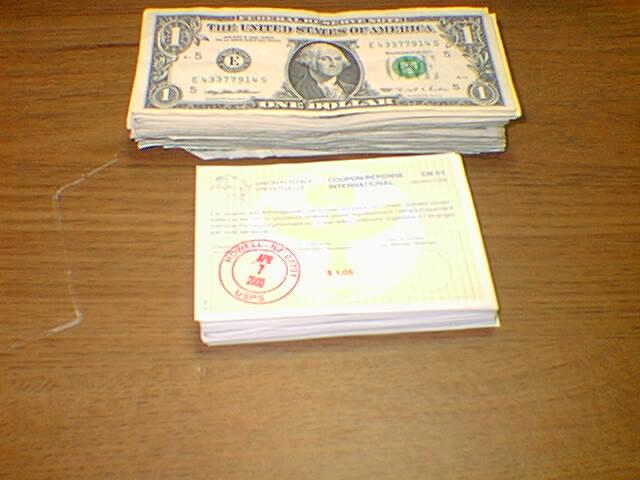
ANDA BUTUH IRC DAN GREEN STAMPS ?


FYI …..
ANDA BUTUH IRC Coupon DAN ATAU GREEN STAMPS ?
UNTUK PARA AMATIR RADIO YANG INGIN DIRECT UNTUK MEMPEROLEH QSLCARD YANG LEBIH CEPAT (UNTUK KLAIM AWARDS, DAN KOLEKTOR KARTU QSL) . 
KAMI MENYEDIAKAN IRC Coupon DAN GREEN STAMPS UNTUK ANDA.
MINIMUM PEMBELIAN : 10 IRC coupon atau 10 GREEN STAMPS.
IRC Coupon masih valid s/d 31 Desember 2013.
BERMINAT?  KHUSUS USER YANG SERIUS (JABODETABEK only)
Di  :  021 2633 4260

March 02, 2012

ARRL International DX Contest - SSB

ARRL International DX Contest - SSB


Phone: First full weekend in March March 3-4, 2012).
Contest Period: 48 hours each mode (separate contests).
Starts 0000 UTC Saturday; ends 2359 UTC Sunday


http://www.arrl.org/arrl-dx

February 05, 2012

ARRL Diamond DXCC Challenge


12/30/2011
ARRL Diamond DXCC Challenge
REVISED December 30, 2011. All 231 entities are now included on the list. Please see the revised entity list.
2012 is the 75th anniversary of the ARRL’s DXCC Award. The world’s preeminent DXing award continues to be DXCC, so reaching the “Diamond milestone” is an event that we all want to celebrate. Going back to the roots of the award, and specifically reading the 1937 DXCC List (January 1937 QST, pages 52-53) to learn what countries were counted at the onset led us to create the Diamond DXCC Challenge.
The country list we will use for the Diamond DXCC Challenge is based upon the list of 231 places shown in 1937. We tried to find corresponding entities today that would represent the places listed in 1937, and we were mostly successful. There are a couple of places that were merged, like French and British New Hebrides, and the Papua and New Guinea Territories. In those places, for 2012 if you work a YJ or a P29 (on the main island of New Guinea) you will get credit for working two entities! Many other oddities are sprinkled throughout the list, too. Returning to the air in 2012 will be the Canal Zone (any HP operating within 8 kilometers of the Panama Canal), the Cities of Gdansk, Poland, and Ifni, Morocco and Balochistan. The list is fascinating and leads us to learn more about world history and how geopolitics has changed leading up to today.
As you “check off” these entities during the course of 2012 working DX (which is an achievement even today) using spotting networks, pan-adapters, 200 watt rigs and stacked tribanders, imagine how DXing was different in the early years of radio and DXCC! Working Tibet or Aldabra with 50 watts and crystal-controlled transmitters to simple wire antennas had to be a thrill like no other in that time for ham radio operators.
We anticipate that this award will be very popular thanks to the unique nature of the entities that we will try to put-into the log in 2012. Not only are there traditional DXCC entities, but there are cities, Islands on the Air (IOTA by RSGB) island groups, and various sub-political entities inside DXCC entities, such as the Indian State of Goa, and many States in Malaysia and islands in Indonesia. There are even three individual “countries” that make up today’s Yemen (7O --Yemen, Socotra Islands and the City of Aden)! Yes, we would like to have even one of them on the air. An interesting factoid about this 1937 list came via the late Jim Maxwell, W6CF. Jim said the only entity from the 1937 list to be removed without a single QSO being made was Wrangel Island.
For some entities that today consist of multiple countries, you may work any of today’s entities to qualify for that single 1937 country. For example, French Equatorial Africa will be considered worked if you log a station in TL, TN, TR or TT in 2012. The Diamond DXCC country tables show the current entity names and prefixes that qualify for the 1937 countries.
The Diamond DXCC Challenge is an “Honor Award” and will not require acquisition or inspection of QSLs or proof of confirmation, although it still will be fun and useful to seek out cards or LoTW confirmations. We will provide forms online to use at your operating position to track what you have worked and forms for applying for awards and endorsements. As the year goes on, we will also provide hints and tips about what is happening with the Diamond DXCC Award and, for instance, who might be on the air from Goa or Gdansk!
The Diamond DXCC certificate will be available for working 100 of the 226 entities, and will be endorsable at 5 levels: 125, 150, 175, 200, and 225. If anyone works all 226, there will be a special award for that remarkable achievement! There will also be awards for the top finishers. We hope to publish award recipients’ call signs online during the year, and identify high numbers.
There will be a Diamond DXCC Challenge Honor Roll. The Honor Roll level will be determined by the leader in worked entities submitted to HQ, and the bottom of the Honor Roll will be 9 entities less than that of the leader. Example: If W1AW has worked 165 entities, the bottom of the Honor Roll will be 156 entities. In February 2013, HQ will issue a final Honor Roll tally with overall leaders.
The entity list is not frozen, so if we discover something significantly in need of change, we will do so and make an announcement.
ARRL Diamond DXCC Challenge Rules
1.        The Diamond DXCC Challenge Awards are available to all amateurs worldwide who contact a minimum of 100 countries from the Diamond DXCC List. US amateurs must be members of the ARRL. Generally, the rules for the Diamond DXCC Challenge are the same as the rules for the DXCC Program, except as listed here.
2.       Contacts must be made from within the same DXCC entity by the same operator.
3.       Contacts must be made during 2012 -- from 0000Z on January 1, 2012, through 2359Z on December 31, 2012. All amateur bands may be used except for 60 meters.
4.       There are no mode endorsements or band endorsements. The Diamond DXCC Challenge is considered to be a Mixed-Mode/Mixed-Band award. There are no power categories or restrictions for the award.
5.       Confirmations are not required to obtain this award, but HQ will review submitted entries for accuracy and validity.
6.       The Diamond DXCC Challenge certificate will be available for working 100 entities and will be endorsable with stickers at the following levels: 125, 150, 175, 200 and 225.
7.       Applications should use ARRL-supplied forms available online or obtained by writing DXCC, 225 Main St, Newington, CT 06111.
8.       The Diamond DXCC Award certificate fee is $12 including shipping within the USA, and $13 including shipping outside the USA.
9.       Endorsement stickers are $1, including shipping in the US, and $2 outside the US.
Thanks to W3LPL, IK2UVR, YO3JW and K9JF for their assistance with this project.

Details info : http://www.arrl.org/news/arrl-diamond-dxcc-challenge

Rules : ARRL Diamond DXCC Chalenge Rules

February 02, 2012

WPX Contest 2011 - 10 Meter SSB LP

YB0NFL, CQ WPX Contest 2011 LP SSB 10 Meters :
#1st OCEANIA
#5th WORLD